Latest half-hour
Wind is the largest source of Britain’s electricity at 11.7 GW (50%).
Generation 23.6 GW, plus Imports 6.8 GW, minus Exports 0.4 GW, equals Demand 30.0 GW.
Share of generation · of 23.6 GW generation
Carbon intensity 96 gCO₂/kWh
- Wind11.7 GW · 50%
- Nuclear5.1 GW · 22%
- Gas3.6 GW · 15%
- Biomass2.0 GW · 8%
- Other0.7 GW · 3%
- Pumped storage0.2 GW · 1%
- Hydro0.2 GW · 1%
Fossil fuels
3.6 GW15%
Gas
3.6 GW15%
Coal
0.0 GW0%
Oil
0.0 GW0%
Wind, solar and hydro
11.9 GW51%
Solar
0.0 GW0%
Wind
11.7 GW50%
Hydro
0.2 GW1%
Other sources
7.9 GW33%
Nuclear
5.1 GW22%
Biomass
2.0 GW8%
Other
0.7 GW3%
Interconnectors
6.4 GWnet import
France
2.0 GWnet import
Denmark
1.4 GWnet import
Norway
1.4 GWnet import
Netherlands
1.1 GWnet import
Belgium
1.0 GWnet import
Ireland
0.4 GWnet export
Northern Ireland
0.0 GWnet export
Storage
0.2 GW1%
Pumped storage
0.2 GW1%
Battery
Not reported separately by the source.
Demand and generation, including embedded
- Imports (demand above generation)
- Demand
- Generation
Contains BMRS data © Elexon Limited copyright and database right 2026. Supported by National Energy SO Open Data. GB solar estimates from Sheffield Solar PV_Live, University of Sheffield, developed with NESO.
Look-ahead
Cleanest time to use power in the next 48 hours: 02:30–04:30 GMT (≈89 g).
Wind is forecast to fall to 6.3 GW by tomorrow evening.
Grid fetched 01:00 GMT · Elexon WINDFOR · Contains BMRS data © Elexon Limited copyright and database right 2026. · National carbon intensity from the NESO Carbon Intensity API (CC BY 4.0). Developed by NESO with the University of Oxford, Environmental Defense Fund Europe and WWF.
Power infrastructure in GB
What is built and what is in the pipeline, from the public registers.
England, Scotland and Wales.
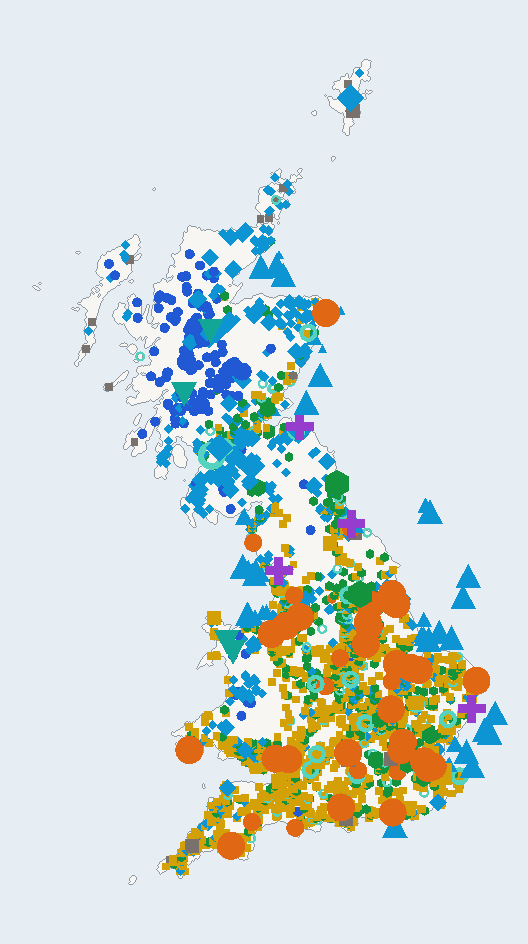
- Under 50 MW
- 50–299 MW
- 300 MW and over
Operating
99.8 GW
3,366 sites
Rated capacity is not published for 49 sites. The gigawatts are the published total.
- Gas31.9 GW 48
- Offshore wind16.9 GW 51
- Onshore wind15.2 GW 750
- Solar12.4 GW 1,538
- Bioenergy and waste7.1 GW 586
- Nuclear5.9 GW 5
- Battery storage4.9 GW 177
- Pumped storage2.9 GW 4
- Hydro1.7 GW 180
- Oil and other0.9 GW 27
- England68.0 GW
- Scotland21.5 GW
- Wales10.3 GW
Pipeline
267.4 GW
7,668 projects
Rated capacity is not published for 991 projects. The gigawatts are the published total.
- Under construction27.9 GW 452
- Consented145.3 GW 5,779
- In planning94.2 GW 1,437
Consent does not mean a project will be built.
Contains public sector information licensed under the Open Government Licence v3.0.
REPD Q2 2026 · DUKES May 2026
Balancing cost
What NESO paid to keep supply and demand matched.
£19.54m on 9 Nov (incomplete: 45 of 48 half-hours).
£2.37bn this financial year, 1 Apr to 9 Nov (8 Nov missing).
What balancing costs, and who paysWhat does electricity cost?
Where is power flowing?
Latest flows
1.43 GWin
1.40 GWin
1.06 GWin
1.00 GWin
1.00 GWin
0.99 GWin
0.26 GWout
0.15 GWout
0.03 GWout
Flows over time
Flows to and from Northern Ireland. NI figures are on a separate page.
How has the mix changed?
Gas and oil prices
Records and the energy transition
Highest wind since Grid's records began
23.9GW
Wed 25 Mar 2026, 13:30 GMT
Lowest carbon since Grid's records began
19g
Mon 15 Apr 2024, 14:30 BST
Days since coal power ended
779
30 Sep 2024
All records and wind milestones · Supported by National Energy SO Open Data
Coal gives way to wind
- Coal, share of generation
- Wind, share of generation
2026: Coal 0% · Wind 30.6% of generation
In 2009, coal supplied 28% of the mix and carbon intensity averaged 444 gCO₂/kWh.
By 2026, coal’s share is 0% and carbon intensity has fallen to 142 g.
Wind has moved from 1% to 31% of generation over the same years.
Supported by National Energy SO Open Data.
How clean is it?
Cleanest time to use power in the next 48 hours: 02:30–04:30 GMT (≈89 g).
Grid fetched 01:00 GMT · NESO Carbon Intensity API